Eye Donation After Death: A Complete Guide
 shraddha trust
Introduction
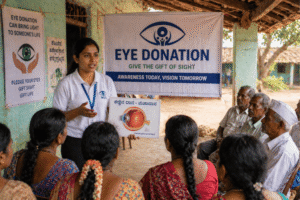
Eye donation after death is the voluntary donation of eye tissue to help people who may benefit from corneal transplantation. The cornea, the clear tissue at the front of the eye, plays an important role in focusing light and providing clear vision.
For people living with corneal blindness, a suitable donated cornea may help restore useful vision. Eye donation is therefore a noble act that can create hope, dignity and a lasting legacy for the donor.
Procedure for Eye Donation After Death
Corneal blindness remains an important cause of vision loss in India, with many new cases being added each year. However, only a small proportion of potential donors are ultimately available for transplantation.
The process of eye donation after death is simple and respectful. After a person passes away, the family should contact the nearest eye bank or hospital as soon as possible, preferably within 6 hours of death. A trained medical team will then guide the family and carry out the eye collection procedure.
Both the cornea and sclera may be used for transplantation. Depending on the procedure, the cornea or the whole eye may be retrieved. A plastic shell can be placed in the eye socket to maintain the donor’s natural appearance.
The collection procedure is safe, dignified and generally takes around 12–15 minutes. The donated corneas are then preserved and assessed for possible transplantation. Suitable tissue can be matched with recipients waiting for vision restoration.
Families who support eye donation after death contribute to an act of kindness that can help another person receive the gift of sight.
Eye Donation After Death: Registration Process for the Donor’s Family
Registering an eye donation pledge helps communicate a person’s wishes regarding donation after death. However, the family also has an important role in making the donation possible.
If the deceased had already pledged to donate their eyes, the family should inform the eye bank promptly after death. Even when there was no previous pledge, relatives may provide consent for donation.
The hospital or eye bank team guides the family through the required consent and documentation process and coordinates the retrieval within the recommended time.
- The family informs the eye bank after death.
- Written consent is obtained as required.
- The medical team assesses the donor’s eligibility.
- Retrieval is arranged within the recommended time.
- The donated tissue is taken to the eye bank for examination and processing.
By supporting their loved one’s decision, families can help extend the donor’s legacy and potentially give another person the opportunity to see again.
Who Cannot Donate Eyes?
Although eye donation is possible for many people, certain medical conditions may make a person unsuitable for donation. Each case is assessed carefully by trained medical professionals before retrieval.
Conditions that may prevent or restrict eye donation include:
- Creutzfeldt-Jakob disease, viral encephalitis and prion diseases
- Communicable diseases such as HIV, hepatitis or rabies
- Severe infections at the time of death
- Certain cancers, including some blood cancers
- Ocular tumours
However, age and several common eye conditions do not automatically prevent eye donation.
- People with cataracts may still be eligible.
- Previous cataract surgery does not automatically prevent donation.
- Poor eyesight does not necessarily make someone ineligible.
- Medical professionals assess the suitability of the corneal tissue before retrieval.
The final decision regarding eligibility is made after appropriate medical evaluation.
Myths and Facts About Eye Donation After Death
Many families hesitate about eye donation because of common misconceptions. Understanding the facts can help families make informed decisions.
Myth: Eye donation will change the donor’s appearance.
Fact: The collection procedure is performed carefully, and the natural appearance can be maintained.
Myth: People who wear contact lenses cannot donate their eyes.
Fact: Wearing contact lenses does not automatically prevent donation unless they have caused corneal damage.
Myth: Eye donation must happen immediately after death.
Fact: The recommended eye donation after death time is generally within 6 hours, so the eye bank should be contacted promptly.
Myth: Eye donation can affect medical treatment.
Fact: Doctors always prioritise saving a patient’s life. Donation is considered only after death has been confirmed.
Myth: Older people cannot donate their eyes.
Fact: Age alone is not necessarily a barrier to eye donation.
Myth: People with cataracts or poor eyesight cannot donate.
Fact: These conditions do not automatically prevent donation because the suitability of the cornea is assessed separately.
Myth: Eye donation is not supported by religious beliefs.
Fact: Most religions endorse eye donation as a noble act of giving.
Myth: People with diabetes or hypertension cannot donate their eyes.
Fact: Diabetes and hypertension do not automatically prevent eye donation.
Why You Should Pledge for Eye Donation
Choosing to pledge your eyes after death is an act of compassion and social responsibility. Donated corneal tissue can help suitable recipients who have lost vision because of corneal diseases.
Thousands of people may require corneal transplantation, while the availability of suitable donor tissue remains limited. Every pledge can therefore contribute to greater awareness and help reduce the gap between the need for and availability of donor tissue.
Eye donation can also create a meaningful legacy beyond one’s lifetime. The decision to donate can potentially help another person regain useful vision and live with greater independence.
Sharing your decision with family members is equally important. When your family knows about your wishes, they can support the donation process after your death.
How to Pledge or Register for Eye Donation at Shraddha Eye Care Trust
Shraddha Eye Care Trust / Medical Team can guide individuals who wish to pledge their eyes after death.
The registration process includes:
- Contact the Shraddha Eye Care Trust eye donation team.
- Complete the eye donation pledge or registration form with the required details.
- Receive confirmation of your pledge, where applicable.
- Inform your family members about your decision.
- After death, the family should contact the eye donation team promptly so that the required process can begin within the recommended time.
Discussing your decision with your family is an important part of eye donation because their cooperation is essential after death.
Conclusion
Eye donation after death can help provide suitable corneal tissue for transplantation and may give a person with corneal blindness the opportunity to regain useful vision.
A decision made during your lifetime can create a lasting impact after death. By pledging your eyes and informing your family about your wishes, you can contribute to the gift of sight and give hope to someone waiting for the opportunity to see again.
A Small Pledge. A Lifetime Of Light.
Register for eye donation and help restore the gift of vision.
Learn More: https://nethradhama.org/eyedonation/
Reach Us: 08062159821