Cataracts in Children: Signs, Causes, Types & Treatment
 shraddha trust
Most people think that cataracts, or Motiyabind, are eye problems that affect only older adults. But children, and even newborn babies, can also develop cataracts.
In a child, a cataract means that the normally clear lens inside the eye becomes cloudy. This cloudiness blocks light from reaching the retina properly, which can make vision blurred or unclear. A cataract can affect one or both eyes and may be present at birth or develop later in childhood.
What makes childhood cataracts more serious is that a child’s vision is still developing. During the early years, the eyes send visual information to the brain, and the brain gradually learns how to see clearly. If a cataract blocks that visual input, the brain may not learn to use the affected eye properly.
Over time, the condition can lead to problems such as amblyopia (lazy eye), eye misalignment, poor visual development, or lasting reduction in vision.
This is why childhood cataract is not only about removing a cloudy lens. Finding it early, treating it at the right time, and continuing proper visual rehabilitation afterward are all important for protecting the child’s developing vision.
Understanding Cataracts in Children
A cataract develops when proteins within the natural lens of the eye become cloudy.
In adults, cataracts mainly reduce already developed vision. In children, the problem is different because the brain is still learning how to process visual signals.
If one eye sends a blurred image for a prolonged period, the brain may gradually start to ignore that eye. This can lead to amblyopia, commonly called lazy eye.
The younger the child, the more important timing becomes because visual development is most active during early childhood.
Signs of Cataract in Children
The most common signs include:
- White or grey reflection in the pupil
- One eye turning inward or outward
- Rapid or uncontrolled eye movements
- Sensitivity to bright light
- Poor response to faces or moving objects
- Frequent squinting
- Tilting the head while looking
- Holding books or objects too close
- Blurred or hazy vision
- Complaints of double vision in older children
Signs of Cataract in Newborns and Infants
Babies cannot explain what they see, so parents often need to identify visible changes.
White or Grey Pupil
One of the most important warning signs is a white or pale reflection in the pupil, known as leukocoria.
A normal pupil usually looks dark or shows a reddish reflection in certain lighting. If the pupil appears white, pale, or abnormal, the child should be examined by an eye specialist.
Wandering or Misaligned Eye
One eye may turn inward or outward.
This is called strabismus and can happen when one eye is not providing a clear image to the brain.
Rapid Eye Movements
Repeated involuntary eye movements are known as nystagmus.
They may occur when vision is significantly reduced, especially when both eyes are affected.
Poor Visual Response
A baby normally starts responding to faces, lights, and moving objects.
If the baby does not follow these as expected, an eye examination may be needed.
Sensitivity to Light
A baby may repeatedly squint, close the eyes, or become uncomfortable in bright light.
Frequent Eye Rubbing
Persistent eye rubbing can sometimes indicate visual discomfort or reduced vision.
Signs of Cataract in Older Children
Older children may be able to describe vision problems, but many adapt to reduced vision and may not realise that something is wrong.
Parents should watch for:
- Blurred or hazy vision
- Frequent squinting
- Head tilting
- Holding books very close
- Using one eye more than the other
- Difficulty seeing in bright light
- Double vision
- Trouble reading or recognising distant objects
A white pupil visible in photographs should also be evaluated by an ophthalmologist.
Types of Cataracts in Children
Childhood cataracts are generally divided into two main categories.
1. Congenital Cataract
A congenital cataract is present at birth.
It may affect one eye or both eyes.
Because a baby’s brain starts developing vision from birth, a dense cataract can interfere with this process rapidly.
Possible causes include:
- Genetic or inherited conditions
- Infections during pregnancy
- Metabolic disorders
- Chromosomal abnormalities
Early assessment is particularly important in congenital cataracts because delayed treatment can affect long-term visual development.
2. Acquired Cataract
An acquired cataract develops later in childhood.
A child may initially have normal vision and later develop lens clouding.
Possible causes include:
- Eye injury
- Long-term steroid use
- Eye inflammation
- Certain metabolic disorders
- Radiation treatment
- Other medical conditions
Even though vision may have developed normally at first, an untreated acquired cataract can still lead to visual problems.
Causes and Risk Factors of Childhood Cataracts
Genetic Factors
Some childhood cataracts are inherited.
If cataracts occur in close family members or are associated with a genetic condition, the risk may be higher.
Infections During Pregnancy
Certain maternal infections can affect the developing eyes of the baby.
These may include:
- Rubella
- Toxoplasmosis
- Cytomegalovirus
- Herpes simplex
- Varicella
Good antenatal care and appropriate vaccination before pregnancy can help reduce some preventable risks.
Medication Exposure During Pregnancy
Certain medicines, including prolonged steroid use and some antiepileptic drugs, may increase risk.
Medication should never be stopped without consulting the treating doctor.
Metabolic Disorders
Some metabolic conditions can affect the eye lens and cause clouding.
Examples include conditions that interfere with the body’s ability to process certain substances normally.
Eye Injury
Trauma is an important cause of acquired childhood cataracts.
A blunt or penetrating injury can damage the natural lens and lead to clouding.
Long-Term Steroid Use
Children who need corticosteroids for long periods may have a higher risk of developing cataracts.
Uveitis
Uveitis is inflammation inside the eye.
In children, it can sometimes develop without obvious redness or pain.
Persistent inflammation can eventually damage the lens and contribute to cataract formation.
Radiation
Children who receive radiation treatment involving the head, brain, or eye area may develop cataracts later.
Idiopathic Cataract
In some children, no specific cause is found even after evaluation.
This is known as an idiopathic cataract.
Can Childhood Cataracts Be Prevented?
Not every childhood cataract can be prevented.
Genetics and some congenital causes cannot always be avoided.
However, certain risks may be reduced through:
- Rubella vaccination before pregnancy
- Proper antenatal care
- Medical review of medicines taken during pregnancy
- Protective eyewear during sports
- Regular eye examinations for children using long-term steroids
- Genetic counselling when hereditary cataract is present in the family
Even when prevention is not possible, early detection can still make a major difference.
How Are Cataracts Diagnosed in Children?
Diagnosis depends on the child’s age and symptoms.
Red Reflex Test
Newborn babies may undergo a simple red reflex test.
A light is directed into the eye, and the doctor observes the reflection.
A healthy eye usually gives a reddish-orange reflection. A white, dull, or absent reflection may indicate an eye problem.
Detailed Eye Examination
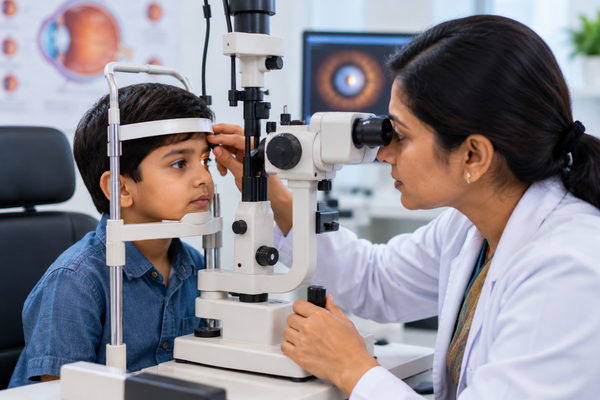
The ophthalmologist may use dilating eye drops to widen the pupil and examine the lens and other structures inside the eye.
Visual Assessment
In babies, vision is assessed by observing whether the child:
- Follows a face
- Tracks a light
- Responds to movement
- Uses both eyes equally
Older children can undergo standard vision testing.
Additional Tests
Blood, urine, or other investigations may be recommended when an infection, metabolic disorder, or genetic condition is suspected.
Can Childhood Cataracts Be Treated?
Yes.
Treatment depends on:
- The child’s age
- Cataract size
- Location of the cataract
- Whether one or both eyes are affected
- How much vision is being blocked
A cataract that significantly interferes with vision usually needs surgery.
Medicines, eye drops, and ordinary glasses cannot clear a cloudy lens.
Childhood Cataract Treatment
Treatment may include:
- Surgical removal of the cataract
- Intraocular lens implantation
- Contact lenses
- Glasses
- Patching therapy
- Regular follow-up
The exact combination depends on the child’s age and eye condition.
Surgical Treatment
During surgery, the cloudy natural lens is removed.
After the lens is removed, the eye needs another way to focus light.
This procedure may be done with:
- An intraocular lens
- Contact lenses
- Glasses
Why Timing Matters
Timing is especially important in babies and very young children.
The brain is actively developing vision during the early months and years of life.
If a dense cataract blocks visual input for too long:
- The brain may start ignoring the affected eye.
- Amblyopia may develop.
- Eye alignment may become abnormal.
- Visual development may remain permanently reduced
This condition is why visually significant congenital cataracts may need early treatment.
Non-Surgical Management
Not every cataract requires immediate surgery.
Small cataracts that do not interfere significantly with vision may sometimes be monitored.
Management may include:
Regular Monitoring
The doctor checks whether the cataract is increasing or affecting vision.
Glasses
Glasses may correct associated refractive errors.
Selected Use of Eye Drops
Eye drops may occasionally be used for specific reasons, but they do not remove the cataract itself.
When Does a Child Need Cataract Surgery?
The decision depends on several factors.
Cataract Location
A cataract in the centre of the lens is more likely to block vision.
Cataract Size
A larger opacity usually interferes more with light entering the eye.
One Eye or Both Eyes
Treatment planning may differ depending on whether one or both eyes are affected.
Effect on Vision
The most important factor is whether the cataract is interfering with normal visual development.
When Is Urgent Cataract Treatment Needed?
Prompt treatment may be required when:
- The cataract blocks the central visual axis.
- It is present from birth.
- The child has a poor visual response.
- One eye begins turning or wandering.
- Vision is clearly being affected.
In these situations, delaying treatment can increase the risk of amblyopia.
Is Cataract Surgery Safe for Babies?
Childhood cataract surgery is a well-established procedure when performed by an experienced paediatric eye surgeon.
It is usually performed under general anaesthesia.
As with any surgery, there are potential risks, which is why careful follow-up is necessary.
Why Childhood Cataract Treatment Is More Complex Than Adult Treatment
A child’s eye continues to grow after surgery.
This means:
- Lens power requirements change
- Glasses or contact lens prescriptions may need repeated updates.
- Eye pressure needs monitoring
- Inflammation may require careful management.
- Visual rehabilitation may continue for years.
Treatment does not end when surgery is completed.
Treatment in Children Above 2 Years
In suitable older children, an artificial intraocular lens (IOL) may be placed inside the eye after cataract removal.
The IOL helps focus light.
Glasses may still be required for additional correction.
Treatment in Children Below 2 Years
In younger infants, immediate IOL implantation may not always be preferred because the eye is still developing rapidly.
After cataract removal, vision may initially be corrected with:
- Contact lenses
- High-power glasses
An artificial lens may be considered later when appropriate.
Why Is IOL Implantation Sometimes Delayed?
A baby’s eye changes significantly during early growth.
The lens power needed at six months may be very different from what is needed a few years later.
Delaying implantation in selected cases allows the surgeon to make a more suitable decision once the eye has developed further.
Recovery After Childhood Cataract Surgery
Immediately After Surgery
The eye may be protected with a shield.
Mild redness, watering, or discomfort may occur.
First Few Days
The doctor may prescribe antibiotic and anti-inflammatory eye drops.
First Few Weeks
Follow-up visits are used to assess healing.
Glasses, contact lenses, or patching may begin during this period.
Long-Term Recovery
Children may need follow-up throughout childhood to monitor:
- Vision
- Eye pressure
- Prescription changes
- Amblyopia
- Other postoperative issues
Why Surgery Alone May Not Be Enough
Surgery removes the cloudy lens, but it does not automatically restore normal visual development.
Additional treatment may be needed.
Patching Therapy
If the brain has started favouring the stronger eye, patching may encourage use of the weaker eye.
Glasses or Contact Lenses
These help provide clear focus after surgery.
Prescription Updates
The required power may change as the child’s eye grows.
Will My Child Need Glasses or Contact Lenses?
Many children will.
Infants without an artificial lens may need contact lenses or high-power glasses.
Children with an IOL may still need glasses for fine visual correction.
Risks Associated With Childhood Cataract Surgery
Childhood cataract surgery is generally safe, but complications can occur.
Infection or Bleeding
These are uncommon but require prompt attention.
Secondary Clouding
The membrane behind the artificial lens may become cloudy after surgery and may need additional treatment.
Raised Eye Pressure
Eye pressure can increase months or years after surgery.
Long-term monitoring is therefore important.
What Happens If Childhood Cataracts Are Left Untreated?
An untreated cataract can interfere with the visual signals reaching the brain.
This may lead to:
- Amblyopia
- Permanent reduction in vision
- Eye misalignment
- Nystagmus in severe cases
The longer a visually significant cataract remains untreated, the more difficult it may become to restore useful vision.
Final Word
Childhood cataracts are uncommon, but they can have a lasting effect on a child’s vision if they are not identified and managed at the right time.
Parents should not ignore signs such as a white pupil, wandering eye, abnormal eye movements, poor visual response, or unexplained blurred vision.
With proper diagnosis, timely treatment, and continued visual rehabilitation, many children can achieve useful vision.
At Shraddha Eye Care Trust, children with suspected cataracts can undergo detailed eye evaluation to understand the type of cataract, its effect on vision, and the most appropriate treatment approach.
Frequently Asked Questions About Childhood Cataracts
1. Are cataracts common in children?
No. Childhood cataracts are uncommon, but they are important because they can interfere with normal visual development.
2. Can a baby be born with a cataract?
Yes. A cataract present at birth is called a congenital cataract.
3. Can childhood cataracts cause blindness?
Yes. A significant untreated cataract can result in severe visual impairment.
4. What is an important sign of a cataract in a baby?
A white or grey reflection in the pupil is an important warning sign.
5. Can a cataract affect only one eye?
Yes. It may affect one eye or both eyes.
6. Can glasses cure childhood cataracts?
No. Glasses may improve focus but cannot remove cloudiness from the natural lens.
7. Does every childhood cataract need surgery?
No. Small cataracts that do not affect vision significantly may sometimes be monitored.
8. Is cataract surgery safe for children?
It is a well-established procedure when performed by an experienced paediatric eye surgeon.
9. Why is patching needed after surgery?
Patching can help encourage the brain to use the weaker eye and manage amblyopia.
10. Why is long-term follow-up necessary?
A child’s eye keeps growing, so vision, prescription, eye pressure, and visual development can continue to change.
Concerned About Your Child’s Vision?
If you notice a white pupil, wandering eye, unusual eye movements, poor visual response, or persistent blurred vision, do not delay an eye examination.
Visit Shraddha Eye Care Trust for a detailed paediatric eye evaluation and childhood cataract assessment.